Showing posts with label Becoming Modern. Show all posts

Friday, 13 April 2012

European Creatives: The Modern Era (late 1800s – 1950s)

Click image above for reviews or to buy this beautiful two-volume, heavily illustrated overview of the major works in Modern Art (and Post-Modern), from Taschen, of course...

Thursday, 12 April 2012

Paul Cézanne: Early Paintings (1866 – 1874)

Skull with Candlestick (1866)

Image of The Murder (1870) with notes at the Liverpool Walker Art Gallery website

Image of The House of the Hanged Man (1874) with notes at the Musee d'Orsay collection on-line

Click image below for reviews or to buy this Taschen book about Cézanne and his work


Paul Cézanne: A Modern Olympia (1874)

Image of this painting, with notes, at the Musee d'Orsay collection on-line

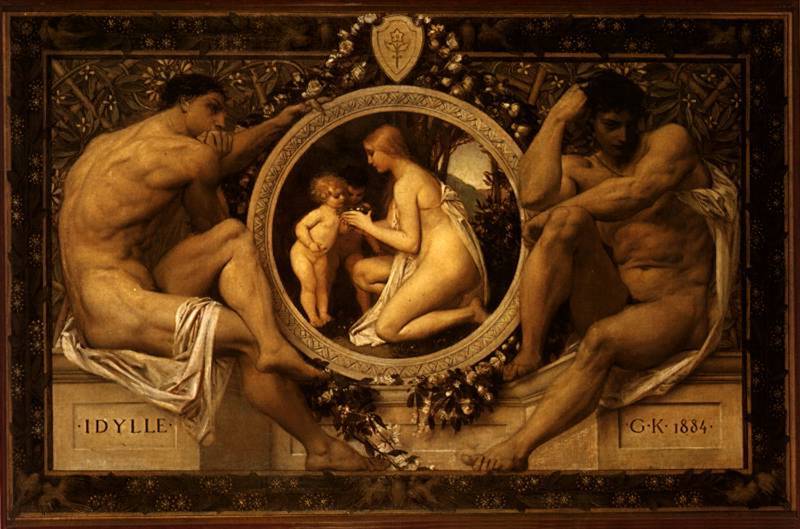
Gustav Klimt: Idylle (1884)


This shows Klimt’s origins in decorative art. Gustav Klimt was part of the Wiener Werkstatte, and resigned from the Viennese Artists Association to become the first president of the Vienna Secession. This was a rebellion against the state-approved art establishment. His move to a more avant-garde approach meant that he lost most of the lucrative state commissions he was becoming famous for, though his fresh approach won him favour with many private patrons and he remained in great demand for portraiture…

Klimt was very influenced by Art Nouveau and Decadent art. He also studied the Neo-Classical and Symbolist art of the Pre-Raphaelites.  Much of Klimt’s work is allegorical, such as Nuda Veritas / The Naked Truth (1899), which has obvious echoes of Aubrey Beardsley, an artist who inspired Klimt. Another connection with Beardsley’s art can be seen in Klimt’s integration of frame into the overall composition of many of his paintings, the portrait of Josef Pembaur (1890) being a fine example.

MORE:

Click image below for more info or to buy this book about the Viennese Secession, led by Gustav Klimt

Georges-Pierre Seurat: Bathers at Asnières (1884)

Georges-Pierre Seurat was a Neo-Impressionist painter, who trained at the École des Beaux-Arts in Paris where he was taught by a disciple of Jean-Auguste-Dominique Ingres, who in turn had been taught by Delacroix. After taking a year from his studies for military service, Seurat exhibited his drawing Aman-Jean at the official Salon in 1883 and was heralded as a bright new star of French art.  However, the following year his painting Bathers at Asnières caused controversy at the Salon and was rejected. This spurred Seurat and several of his colleagues to found the Societe des Artistes Independants. This Society of Independent Artists staged their own exhibitions and, in time, these art shows eventually became more popular and relevant than those of the official Salon.


Often referred to as “the first Modernist masterpiece”, this is a large oil on canvas (just over 10 feet across) that began the shake-up of modern art. The size of the canvas was shocking because of its subject matter. Such large canvasses were the preserve of important historical subjects, but Seurat thought that these ‘noble workers’ were as important as the people in grand historical paintings hung in museums.

His technique was also a great innovation. The green colour of the grass, for example, is made up of dots of pure colours including yellow, pink, blue and orange, yet our eye mixes these colours to give the vivid grass green of summer meadows. This is the beginnings of Pointillism (painting small dots of pure colour with just the tip of a brush), though it is used alongside smoother, blended brushstrokes here.

Although the scale of the figures are inconsistent, the composition closely follows the Golden Section rules of classic Renaissance paintings, also aligning this working class scene with the great works of art exhibited in palaces and state museums. It was produced as France neared the centenary of its Revolution and therefore was explicitly political, and intentionally critical of the governing elite.

MORE:

Image of this painting at London's National Gallery Collection on-line

Georges-Pierre Seurat: Sunday Afternoon on the Island of La Grande Jatte (1883 – 86)

Another large canvas, this is the seminal Divisionist work entirely using Pointillism with strong areas of contrasting light and shade. There is also a tension between the flatness of the stylised forms, inconsistent perspective and the great depth implied through the traditional perspective thus uniting Renaissance sensibility with the Modern approach. Seurat was fascinated by the problem of using pigment to represent reflected light and hoped that through the use of pure colour applied meticulously with the tip of a brush, his method of Pointillism would create much more vivid colour. He made many sketches and studies when planning this piece and took more than two years to complete the finished painting.


La Grande Jatte was a fashionable leisure spot for wealthy Parisians and is opposite the riverbank at Asnières – the row-boat seen in the previous painting is heading here. Whereas the bathers at Asnières are enjoying limited leisure time whilst their factories loom in the hazy background, here the scene has a stillness and timelessness about it, and from this side of the river the factories are obscured by trees.

Here, though, many of the figures are reduced almost to graphic motifs and are not portrayed in as real a way as the bathers were. In fact they are made to look toy-like, almost wooden. So here are the rich, fashionable elite strolling in the patchwork shade of decorative trees in the stiffness of their fine clothes. They are less human than the working class, and some of these rich folk are looking toward the Asnières bank of the river in a way that seems perhaps envious. As they are stifled in buttoned-high dresses and jackets, the workers are shirtless and splashing in the cool waters. It is only the children, animals and one man who are portrayed as natural and relaxed.

The man at the bottom left of the canvas seems a little out of place and he is the only person with a natural face that could possibly be a portrait. His arms are bare and the pipe he smokes is a simple, cheap type. He is probably the ‘butler’ of the nearby picnicking couple, or the oarsman who has rowed them along the river. His foot actually extends beyond the edge of the composition toward the bathers. Perhaps he has ‘a foot in the other camp’, his allegiance lying with his working class comrades.

MORE:

Fine scan of this painting, with accompanying text by Sister Wendy, at the Artchive

Paul Cézanne: Hillside in Provence (1887ish)

Image of  this painting at London's National Gallery Collection on-line

Georges-Pierre Seurat: Models (1888)

Image of this painting at the Seurat pages at Olga's abc Gallery

Georges-Pierre Seurat: Sideshow (1888)

Image of this painting at the NY Metropolitan Museum of Art website

Vincent Van Gogh: The Yellow House (1888)

This remarkable painting is of the house in Arles where Vincent lived during his most revolutionary and prolific period from 1888 until his demise. He rented the right half as we see it in the painting, with the distinctive green shutters. 


Here we have a cheering autobiographical work, the house seems to glow with its own light against the deep blue of the sky, and careful observation reveals both blues and oranges in the roofing tiles, giving the vibrancy and optimistic atmosphere. Reading the picture from left to right we see a tree that stands in the corner of the local public park, then the pink canopy of the café where Vincent would usually eat his meals, when he could afford to. To the right we find a typical small café terrace on the side of the road that Vincent often passed when walking to visit his friend, Joseph Roulin, a postman that Vincent produced several paintings of, easily recognisable by his very fine beard. The railway bridge is seen as representing both the wider world and the future.

Vincent Van Gogh: Vincent’s Room (1888)

The beginnings of both Expressionism and Fauvism can be seen here in this painting of his own room in ‘the yellow house’. This is what lies behind the green shutters of the upper floor in the Yellow House. 


He was directly influenced by Japanese prints in this composition and the perspective is skewed and forced. The colour and prominence of each object reflects not only how the room looked, but also an emotional relationship with each thing and its surroundings. In this work, we can also appreciate the simplicity of his life and although he is not figuratively represented, this is also very much a self portrait.

Vincent Van Gogh: Sunflowers (1888)

This is one of the most famous and popular images of all time, often reprinted and sold as cards and prints. The yellow and cream of the background is reversed in the vase, using line to contain fairly flat blocks of each colour. The cream of the wall is graduated into blue to increase the vibrancy of the sunflower yellow. There is no traditional perspective though the arrangement of flower heads still seems to have some depth. The form of the flowers is suggested by their finely observed treatment and subtle differences in colour and there is no chiaroscuro. 


Vincent painted a series of sunflower studies to decorate the room at ‘the yellow house’ in which Paul Gauguin stayed during his extended visit to Arles. Vincent had hoped that he could establish a sort of artists’ quarter in Arles where like-minded creatives could form a community of mutual support producing adventurous paintings, poems and sculptures.

Paul Gauguin: The Vision After the Sermon (1888)

Vincent Van Gogh: Irises (1889)

This vibrant painting depicts a well chosen arrangement of flowers, each well observed from life and painted with great care and attention to detail. The use of yellow in the background effectively makes the blue of the irises ‘pop’, with the single white flower eventually attracting the eye to settle and giving the composition focus and an almost narrative movement. The use of dark outline and bright colours gives the impression of a stained glass window. 


This is a good example of Van Gogh’s ongoing process of liberating colour from its duty of form by using strong outlines. Although the brush work is controlled and relatively smooth, the Van Gogh energy remains very evident. This painting sold at auction in 1987 for £25.5 million, the bidding started at £15 million and lasted less than 2 minutes. At the time, this was the most ever paid for a painting…

MORE:

Click image below for more info or to buy this book focussing on Van Gogh's flower paintings

Vincent Van Gogh: Starry Night (1889)


This was painted from memory whilst Vincent was a voluntary patient at the asylum of Saint-Remy, and features an idealised version of a small town. It is a strikingly vivacious painting that goes much further than being a mere impression of a starlit night. It evokes the simple wonder and awe of a bright, clear night sky and conveys the euphoric feeling that can accompany such a moment. The emotional response of the artist is in every brush stroke and choice of colour. It is not simply a landscape, it is a poetic rendering of the relationship between the inner and outer landscapes of the human mind and the universe! This goes beyond Impressionism and is truly a work of Expressionism.

The scene is also a ‘potted biography’ containing a montage of scenes from his life and also a visual treatise on his changing values and beliefs. In the scene we notice several things, first and foremost the swirling starry sky with its milkyway and golden moon. Again, the vibrancy is achieved by clever use of his favourite colour combination – blue and yellow. After we have been drawn into the painting by the wondrous sky, we notice the strange looming shape of a cypress tree that reaches from the bottom of the composition almost to the very top. It is so bold that we must consider it to have some significance. Its shape and proportioning are so very similar to the shape of the much smaller church at the lower centre of the image. This church is evidently recognisable, from his own earlier drawings, as the church in the Borinage region of Belgium, where he was assigned as a missionary to the local community of coal miners.

His calling as a priest had been all-consuming for three years up until 1879 when he left the church. He then began his artistic career in earnest, recording the locals, their impoverished way of life and the landscape in which they worked. It seems that he became disillusioned with the church and its judgemental stance, feeling that it did little to console or uplift the morale of these hard-working honest-living peasants. He later found the ecstatic elation he had hoped for, not through his devotion to the church, but through art inspired by nature. We can read all this in Starry Night

The only non-celestial light in the painting comes from the homes in the valley. It is the warm light of lamps and hearths, hinting at the emotional warmth of simple family life. The church is empty, its windows in darkness. Its spire points to the heavens and indeed its tip passes above the mountains and pierces the sky, but only just. This tells us that formal religion can show us the way, but might not be there when you need it, and only takes us part way. The cypress tree is not man made, it is a natural structure and its steeple like shape takes us right up into the heavens amongst the stars. To Van Gogh, the feeling of wonder he experienced when considering the grandeur of creation, the power of nature, the vastness of the night sky came closer to the religious experience than anything offered by the church. 

In this painting, he evokes the notion of the sublime, placing him in the Romantic tradition, his ‘religious experience’ equating with the their ‘peak experience’. Also, by creating an improvised landscape rather than a literal representation, he has produced a work that could be considered as both Expressionist and Surrealist, as well as giving us an important precursor to the Improvisations of Wassily Kandinsky.

MORE:

This and many other images of the work of Van Gogh, plus plenty of info, can be found at the on-line Vincent Van Gogh Gallery

Vincent Van Gogh: Self-Portrait (1889)

Vincent painted himself many times, partly because he could not afford to pay models to sit for him. Here we can see Fauvist influences in what appears immediately to be a fine portrait. When we take note, though, we realise that the flesh tones are mainly non-naturalistic greens and yellows, which make his red hair even more fiery. 


Unlike Matisse or Gauguin, he does not rely on flattened colour here, instead filling the canvas with energetic swirls. The brushwork is flowing and lively around the outer areas, becoming more contained toward the centre, most controlled around the highly expressive eyes which fix and return the viewer’s gaze. This technique is a visual reference to self portraits by Rembrandt. 

MORE:


Click image above for reviews or to buy this book focussing on Van Gogh's own letters and preparatory sketches for his self-portraits, or...
Click image below for this very affordable Kindle book about his portraits of others and of himself

Vincent Van Gogh: Wheatfield Under Threatening Skies (1890)

Probably Vincent’s last painting, certainly among the last few, this is a strongly narrative picture that is an externalisation of the internal. It can be interpreted as an Expressionistic representation of Vincent’s own inner landscape. Divided in two, between the bright sunny fertile field and ominous darkly threatening storm clouds, the painting is vigorous and impassioned, with Vincent using his fingers and both ends of the brush to hack and work into the paint. Vincent swung from extreme passion and euphoria, when he was painting, to deep despair and depression, linked with his undiagnosed condition (now thought to be a form of epilepsy).


Here we see the bright, fruitful wheat that represents creativity thrashed about in the strong winds with the inevitable rains about to beat down the harvest, under the bleak impending clouds of doom. The canvas is almost half-and-half, bright versus dark as Vincent’s life had been, but in this painting, the crows have been added, bringing the black down into the brighter lower half, corrupting the vibrant yellow of the wheat. A path swings into the painting and takes the viewer into the middle of the canvas where it seems to end, indicating no clear direction.

This is a painting of the path that Vincent walked along, into the middle of the field where he was shot in the stomach, before walking back and returning to his room, where he died two days later. No one knows for sure the details of these events, but the generally accepted explanation of suicide has been brought into question and one credible theory is that Vincent was accidentally shot by a teenager whom he knew, and rather than implicate the boy, allowed people to believe he had shot himself.

MORE:
Image of this painting at the WebMuseum Van Gogh pages

Wednesday, 11 April 2012